Welcome to C&Q amusement website!
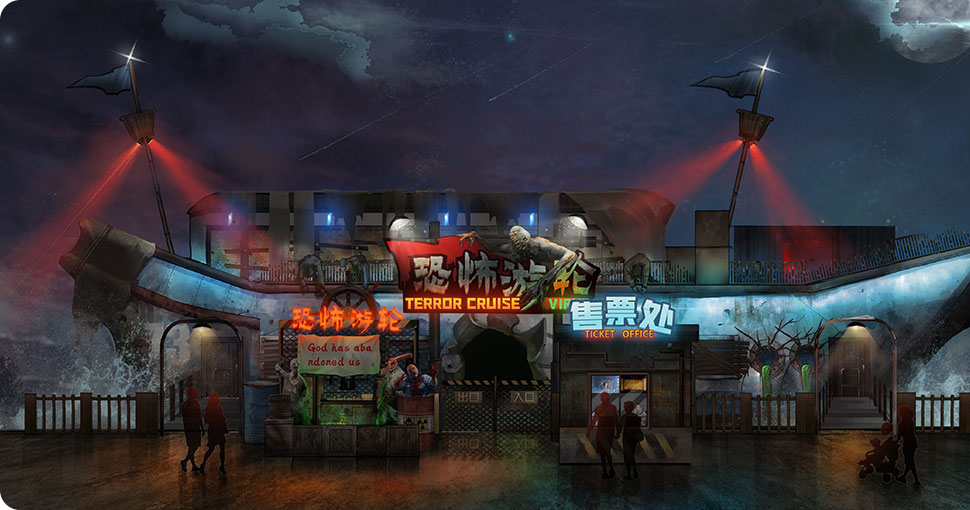
A cruise ship already has a strong sense of movement, enclosure and exploration before any horror elements are introduced. Long corridors, passenger cabins, service areas, stairways and enclosed entertainment spaces naturally create a sequence of environments that can be transformed into an immersive attraction. When these spaces become part of haunted cruise ships, however, the design challenge goes beyond creating convincing scares. Every change in lighting, scenery, sound or guest movement can affect how safely and efficiently visitors move through the attraction.
This is why a successful haunted cruise needs to be designed as both an entertainment environment and a carefully managed visitor system. A narrow passage can increase suspense, but it can also become a bottleneck. A sudden scare can make guests stop or change direction. A highly immersive scene can obscure the visual cues that normally help people understand where to go next. These effects are valuable from a storytelling perspective, but they need to be anticipated when planning capacity, circulation and emergency response.
The most effective approach is to establish the operational framework before the attraction becomes visually complex. Guest capacity, scare-zone transitions, emergency egress, staff access and monitoring should be considered alongside the creative concept rather than treated as separate technical issues. This allows haunted cruise ships to deliver a more convincing visitor experience while giving operators the control needed to manage real-world conditions during live operation.
Darkness is one of the easiest ways to change the atmosphere of a haunted cruise. A familiar corridor can become unfamiliar simply by reducing visibility and changing the way light falls across walls, doors and floor surfaces. From an attraction design perspective, however, darkness also changes how visitors judge distance, movement and obstacles.
A guest entering a dark scene may slow down because the path ahead is unclear. Another visitor may stop after hearing a sudden sound or seeing a performer emerge from an unexpected position. If several people react in the same area, the resulting delay can affect the group behind them. The attraction therefore needs to accommodate natural visitor reactions rather than assuming that every guest will maintain a constant walking speed.
Lighting should be considered at several levels. The theatrical lighting can remain intentionally dramatic, but the underlying environment still needs to support safe circulation, staff intervention and emergency access. Designers should pay particular attention to changes in floor level, tight corners, doorways, steps and areas where scenic elements reduce the usable walking width.
Special effects introduce another variable. Fog, projection, directional sound, lighting effects, moving scenery and animatronic elements can change the visitor's perception of space. A scare effect positioned close to a circulation route may cause guests to move sideways, stop suddenly or turn toward the person they entered with. These reactions can be part of the intended experience, but they should be considered when determining the amount of space available around the effect.
Confined spaces deserve similar attention. A narrow corridor can create a strong feeling of suspense because visitors have fewer visual escape points. At the same time, it leaves less room to absorb unexpected behaviour. If a visitor stops in the middle of the passage, the following group has limited options for moving around them.
For haunted cruise ships, effective safety design is therefore not about removing every element that makes the attraction frightening. It is about understanding how each element changes visitor behaviour and designing enough operational flexibility around it.

Capacity planning for a haunted cruise should start with the actual visitor journey rather than simply the floor area of the attraction. A room may physically accommodate a certain number of people, but that does not mean the same number can move through it comfortably when the scene includes performers, scenery, sound effects or moments that naturally cause visitors to stop.
Several capacity factors need to work together. Occupancy concerns how many people are inside a particular area at one time. Throughput concerns how quickly visitors can pass through the attraction. Egress capacity concerns how effectively people can move toward a safe location when normal operation is interrupted. A change to one of these factors can affect the others.
For example, increasing the number of guests released into the attraction may appear to improve throughput. If the next scare zone is narrower or consistently causes visitors to pause, however, the additional guests will eventually accumulate there. The result can be longer dwell times, reduced separation between groups and a less controlled visitor experience.
For haunted cruise ships, it is useful to map the complete guest route from entry to exit and identify where movement is likely to change. A long corridor may support relatively continuous circulation, while a detailed theatrical room may encourage visitors to stop and observe their surroundings. A transition between the two can therefore become a critical point in the capacity model.
| Design consideration | Potential effect on the attraction | What designers should examine |
|---|---|---|
| Guest occupancy | Determines how much usable circulation space remains | Actual usable area and applicable occupancy requirements |
| Guest throughput | Influences queue length and attraction operating efficiency | Movement through the slowest sections rather than average walking speed alone |
| Scene dwell time | Guests may pause after a scare or during a visual sequence | Transition space and separation between groups |
| Emergency movement | Normal circulation may change significantly during an incident | Evacuation routes and potential congestion points |
| Staff access | Operators may need to reach guests, performers or equipment | Access routes that remain practical during live operation |
There is no single throughput figure that can be applied safely to every haunted cruise. The appropriate operating capacity depends on the attraction's physical configuration, applicable local requirements, guest behaviour and emergency planning. For that reason, capacity should be established as part of the overall attraction design instead of being treated simply as a target number of visitors per hour.
In a well-designed haunted cruise, visitors should rarely notice the crowd-management system behind the experience. They should feel as though the attraction is naturally leading them from one scene to the next. Achieving that effect requires much more attention to circulation than simply designing individual scare zones.
The transition between two scenes can be just as important as the scenes themselves. After an unexpected effect, visitors may stop to understand what happened, look back at a performer or wait for someone in their group. If another group enters immediately behind them, the available circulation space can disappear quickly.
This is particularly relevant to haunted cruise ships because the available space may already be constrained by the existing ship structure. Corridors, doorways and enclosed rooms cannot always be expanded without affecting the character or functionality of the venue. Instead, designers may need to manage the pace at which guests enter each section and consider how much space is available for temporary pauses.
A larger transition area before a narrow scene can help absorb variations in visitor speed. Controlled release points can prevent groups from entering a busy section too closely together. In some layouts, the sequence of scenes can also be arranged so that a high-dwell area is followed by a section that naturally encourages movement, helping the attraction regain its spacing.
Staff observation provides another layer of control. During live operation, supervisors can identify recurring patterns that may not be obvious on a drawing. If a particular effect repeatedly causes visitors to stop, the release interval may need to change. If one corridor consistently clears more slowly than expected, operators can adjust upstream entry rather than allowing congestion to spread through the attraction.
The objective is not to make every visitor move at exactly the same speed. A more practical goal is to create enough flexibility for normal variations in guest behaviour without allowing those variations to develop into persistent congestion.
Emergency egress needs to remain dependable even when a haunted cruise is operating at its busiest. This can be challenging because the attraction is intentionally designed to alter the appearance and atmosphere of its surroundings. A corridor that feels mysterious during normal operation still needs to function as an accessible evacuation route when an incident occurs.
Required exits and means of egress should therefore be considered independently from the theatrical storyline. Scenic walls, props, temporary installations and attraction equipment should not compromise required routes. Areas needed for emergency access should also remain available throughout operating hours rather than being treated as convenient locations for storage or temporary scenic elements.
Accessibility should be addressed at the same stage. Visitors may have different mobility, sensory or communication needs, and emergency procedures should reflect the possibility that some guests may require assistance. The practical evacuation strategy needs to correspond to the actual building, attraction layout and local requirements rather than relying on a generic procedure.
Normal visitor circulation and emergency movement also need to be examined separately. A route that performs well when small groups are walking through an attraction may behave differently when a larger number of people need to leave at once. Designers should identify locations where doorways, corridors, stairs or changes in direction could affect evacuation movement.
For haunted cruise ships, the basic principle is straightforward: the attraction can intentionally make the visitor experience feel confusing, but the emergency infrastructure cannot depend on that confusion. Required evacuation routes must remain usable and accessible in accordance with the regulations applicable to the project.
Because fire, building, accessibility and life-safety requirements vary by jurisdiction and site, final egress arrangements should be reviewed by appropriately qualified local professionals and the relevant authorities.
Even a carefully planned attraction can behave differently once real visitors enter the space. This makes live operational management an important part of haunted cruise safety. The design establishes the framework, but staff determine how effectively that framework responds to changing conditions.
Operators, performers and supervisors need clearly defined responsibilities. If a guest becomes distressed, an attraction effect stops unexpectedly or congestion begins to develop, staff should know how the situation is communicated and who is responsible for taking action. Clear procedures become particularly important when different attraction zones are separated by walls, corridors or other visual barriers.
Performer positions should also be considered from an operational perspective. A performer needs enough space to work without unintentionally blocking guest circulation or making staff intervention difficult. Their location should be coordinated with scenery, lighting and equipment so that the theatrical effect does not create unnecessary obstacles.
The same principle applies to attraction equipment. Equipment should not only be evaluated according to how it contributes to the visual or interactive experience. Maintenance access, staff visibility, operating clearances and the relationship between equipment and guest movement also need to be considered.
For attraction developers reviewing equipment solutions as part of a wider themed project, CQA Amusement's amusement products can be evaluated alongside the intended attraction concept and operating environment. Considering equipment selection together with the visitor journey can make it easier to identify practical requirements before the installation stage.
Communication between different attraction zones is another important part of live operation. If one section begins to fill up, operators farther upstream may need to slow or temporarily control guest entry. This creates a connected operating system rather than leaving each area to respond independently.
Monitoring can also reveal issues that are difficult to predict during the design stage. A scene may consistently take longer to clear than expected, or a particular sound or visual effect may cause visitors to pause in an unexpected location. These observations give operators an opportunity to refine procedures while keeping the attraction's intended character intact.
When a project requires discussion about equipment selection, customized attraction requirements or the practical integration of amusement solutions, developers can contact CQA Amusement to discuss the project with the team. Early communication can help align the attraction concept with the equipment and operational requirements before those decisions become difficult to change.
Designing haunted cruise ships involves much more than creating convincing horror scenes. The ship itself becomes part of the attraction, which means its corridors, enclosed spaces, circulation patterns and existing infrastructure all influence how visitors experience and move through the environment.
A successful haunted cruise needs to account for the way guests actually behave. People may stop after a scare, move unpredictably through a dark scene or slow down when a space becomes visually confusing. Capacity planning needs to reflect those variations, while scare-zone transitions need to provide enough flexibility to prevent small delays from becoming larger crowd problems.
At the same time, emergency egress must remain independent of the theatrical experience. Required routes need to stay accessible, and staff need practical procedures for monitoring the attraction and responding when normal operation changes.
When guest flow, capacity, equipment, scenic design and emergency planning are considered together from the beginning, safety does not have to compete with immersion. Instead, it becomes the operational foundation that allows haunted cruise ships to deliver a more controlled, convincing and repeatable visitor experience.
The main considerations include reduced visibility, confined spaces, crowd congestion, unexpected guest reactions, special effects and restricted access for staff or emergency response. The specific risks depend on the attraction's layout and operating conditions.
Capacity depends on the physical layout, applicable occupancy requirements, guest movement, throughput, staff access and emergency egress. The final operating capacity should be established according to the requirements applicable to the specific project.
Controlled crowd flow helps prevent groups from accumulating in narrow areas and maintains appropriate separation between visitors. It also helps preserve the intended pacing of different scenes.
Yes. A themed environment can be designed around required egress routes, provided that exits and evacuation paths remain accessible and comply with the requirements applicable to the project.
Operators can use controlled guest release, staff observation, communication systems and established emergency procedures. The attraction layout should also anticipate behaviours such as stopping, turning around or moving unexpectedly after a scare.
Developers should consider the attraction narrative, guest circulation, capacity, scare-zone transitions, emergency egress, accessibility, performer positions, monitoring, equipment integration and applicable safety requirements. Addressing these factors during early design can reduce operational conflicts later in the project.
 English
 中文